
Time dilation facts for kids
Time dilation is a real physical effect where time passes at different speeds for different people. It depends on how fast someone is moving or how close they are to a heavy gravitational object like a planet or a star.
Imagine you have two identical clocks synchronized to tick at the exact same rate. If you leave one clock on Earth and put the other inside a super-fast spaceship, the two clocks will no longer match when the spaceship returns. The clock on the speeding spaceship will have ticked fewer times than the clock that stayed on Earth.
This strange behavior is not a mechanical flaw in the clocks. Instead, it shows that time itself stretches and flows at different rates throughout the universe. Time dilation is a major part of the theory of relativity introduced by the famous physicist Albert Einstein in the early 20th century. Today, scientists use these principles to make sure systems like satellite navigation and GPS function properly.
Contents
- What Is Time Dilation and How Does It Work?
- Velocity Time Dilation: Moving Fast Slows Down Time
- Gravitational Time Dilation: How Gravity Shapes Time
- Real-World Applications and Scientific Experiments
- Time Dilation in Science Fiction and Popular Culture
- Summary of Key Ideas
- Images for kids
- Related Pages
What Is Time Dilation and How Does It Work?
In our daily lives, we usually assume that time ticks at the exact same speed for everyone. An hour in a classroom feels like the same hour at home. However, modern physics proves that time is relative. This means your measurement of time depends entirely on your motion and your position in space.
There are two main ways time dilation happens in nature:
- Velocity time dilation: The faster an object moves through space, the slower time passes for it compared to a stationary observer.
- Gravitational time dilation: The stronger the gravitational pull acting on an object, the slower time passes for it compared to an object in weaker gravity.
Because humans normally travel at very slow speeds compared to light, we do not notice these effects in our daily routines. However, at extreme speeds or near massive objects like black holes, the differences become enormous.
The Speed of Light as a Universal Speed Limit
To understand why time changes, one must look at light. In physics, the speed of light in empty space is always constant. It travels at about 299,792 kilometers per second (roughly 186,282 miles per second), often represented by the letter c.
According to Einstein's theory of special relativity, the speed of light never changes, no matter how fast you are moving toward or away from the light source. Because the speed of light must remain constant for all observers, other measurements—like distance and time—must stretch or shrink instead.
Velocity Time Dilation: Moving Fast Slows Down Time

Velocity time dilation occurs whenever two observers move relative to each other. When someone moves very quickly, their clock ticks slower from the viewpoint of someone standing still.
This effect increases dramatically as an object gets closer to the speed of light. At everyday human speeds, such as riding a bicycle or flying in a commercial airplane, the time difference is only a tiny fraction of a second. But if a spacecraft could travel at 90% or 99% of the speed of light, years on Earth would pass in what feels like mere days or weeks for the travelers.
The Thought Experiment of the Light Clock

Scientists explain velocity time dilation using an imaginary device called a "light clock."
Imagine a clock made of two parallel mirrors facing each other, separated by a distance L. A single particle of light (a photon) bounces straight up and down between the mirrors. Every time the light pulse hits the bottom mirror, the clock records one "tick."
- When the clock is standing still: The light pulse simply goes straight up and down over a total distance of 2L. The time between ticks is the distance divided by the speed of light:

- When the clock moves sideways: Imagine this clock is mounted inside a fast-moving glass train. To a passenger inside the train, the light still bounces straight up and down. But to an observer standing outside on the platform, the clock is moving forward while the light travels. Therefore, the light pulse must follow a longer, diagonal path to hit the mirrors.
Because the speed of light cannot speed up to compensate for this longer diagonal path, it takes more time for the photon to complete a single bounce. For the stationary person on the platform, the moving clock takes longer between ticks. This proves that the moving clock runs slower than the stationary one.
Calculating the Time Difference
Using the Pythagorean theorem on the triangle formed by the moving light beam, physicists calculate the exact mathematical relationship between moving time and resting time.
The formula for time dilation is:
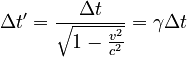
In this equation:
 is the time measured by the person holding the clock (known as proper time).
 is the time measured by the outside observer watching the clock move.
 is the velocity of the moving object.
 is the speed of light.
- The symbol
 (the Greek letter gamma) is called the Lorentz factor.
As speed gets closer to , the bottom of the fraction gets smaller, which causes the Lorentz factor to grow larger. If an object could reach the speed of light, time for that object would effectively freeze from the perspective of an outside observer.
The Twin Paradox Explained

The strange nature of velocity time dilation leads to a famous puzzle called the twin paradox.
Imagine identical twins named Alex and Sam. Sam stays at home on Earth, while Alex boards a high-speed rocket ship that travels across deep space at 90% of the speed of light. After traveling for what feels like 5 years on board the spacecraft, Alex turns the ship around and flies back to Earth.
When Alex lands, Alex has aged 10 years. However, back on Earth, Sam has experienced over 22 years of time. Sam is now noticeably older than Alex, even though they were born on the exact same day!
Why does this happen? The situation is not symmetrical. To leave Earth, turn around at the destination, and come back to a stop, Alex had to accelerate and change directions. This change in speed and direction means Alex changed reference frames, making Alex the one who traveled through less overall time.
Gravitational Time Dilation: How Gravity Shapes Time

Einstein's theory of general relativity expanded the study of time by including gravity. General relativity shows that massive objects—such as planets, stars, and black holes—warp the fabric of spacetime around them.
Because gravity curves space and time, clocks closer to a massive body tick slower than clocks that are farther away in weaker gravity.
For instance:
- A clock placed on the surface of the Earth runs slower than a clock placed at the top of Mount Everest.
- A clock placed deep inside the Earth's core runs slower than a clock resting on the planet's outer crust. Physicist Richard Feynman pointed out that because of this effect, Earth's center is actually about 2.5 years younger than its surface, even though the planet formed over 4.5 billion years ago!
- Near the event horizon of a massive black hole, gravity is so intense that time slows down almost completely relative to the distant universe.
Unlike velocity time dilation, which is symmetrical between two moving observers in uniform motion, gravitational time dilation is agreed upon by everyone. Both observers will agree that the clock closer to the heavy mass is running slower than the clock farther away.
Real-World Applications and Scientific Experiments
Time dilation is not just an idea from science fiction; it is a proven fact of nature verified by decades of real-world experiments.
Real Time Differences for Astronauts
Astronauts orbiting Earth on the International Space Station (ISS) travel at high speeds of roughly 27,600 km/h (about 7,700 m/s). At the same time, they are over 400 kilometers above the planet, where Earth's gravitational pull is slightly weaker.
These two effects compete with each other:
- Their high orbital speed makes their clocks run slower (velocity time dilation).
- Their higher altitude makes their clocks run faster (gravitational time dilation).
On the ISS, the speed effect wins out over the altitude effect. After spending 6 months on the space station, an astronaut returns to Earth having aged roughly 5 milliseconds (0.005 seconds) less than people on the ground. Cosmonauts like Sergei Krikalev and Sergey Avdeev, who spent years in space across multiple missions, have traveled approximately 20 milliseconds into the future compared to Earth time.
Muons from Cosmic Rays

One of the earliest and clearest natural proofs of time dilation came from the study of subatomic particles called muons.
When high-energy particles from space (cosmic rays) collide with the upper atmosphere, they create unstable particles called muons. In a laboratory at rest, a muon decays in just 2.2 microseconds (2.2 millionths of a second). Even traveling near the speed of light, a muon should only be able to travel about 660 meters before decaying. They should never be able to reach the surface of the Earth from high up in the atmosphere.
Yet, scientific detectors at sea level detect large numbers of these muons every second. This happens because the muons travel at over 99% of the speed of light. From our perspective on Earth, their internal clocks are stretched out by time dilation, allowing them to survive long enough to complete the journey down to the surface.
The Hafele–Keating Airplane Experiment
In 1971, physicists Joseph Hafele and Richard Keating conducted a famous experiment to test time dilation directly. They took four highly accurate caesium atomic clocks and flew them around the world twice on commercial passenger airplanes—once flying eastward and once flying westward.
After the flights, they compared the airborne clocks to reference clocks kept at the U.S. Naval Observatory.
- On the eastward trip, the airplane moved in the same direction as Earth's rotation, increasing its net speed. The flying clocks lost around 59 nanoseconds relative to the ground clocks.
- On the westward trip, the airplane flew against Earth's rotation, reducing its net speed while gaining altitude. The flying clocks gained around 273 nanoseconds.
The measured numbers matched Einstein's theoretical predictions almost perfectly. In 2005, scientists at the National Physical Laboratory in the UK repeated the test with modern equipment and confirmed the same results with even greater precision.
How GPS Systems Rely on Relativity

Every time you use a smartphone map, a car navigation unit, or track a package, you are using time dilation corrections.
The Global Positioning System (GPS) consists of dozens of satellites orbiting roughly 20,200 kilometers above the Earth. Each satellite carries precise atomic clocks that transmit timing signals down to receivers on the ground.
Because of where and how they operate, two relativistic effects occur at once:
- Velocity effect: The satellites travel at about 14,000 km/h, causing their clocks to tick slower by about 7 microseconds per day.
- Gravitational effect: The satellites sit much farther out of Earth's gravitational field, causing their clocks to tick faster by about 45 microseconds per day.
When you combine both effects (+45 minus 7), the satellite clocks run faster than Earth clocks by roughly 38 microseconds (0.000038 seconds) every single day.
While 38 microseconds sounds tiny, light travels about 300 meters in a single microsecond. If engineers did not program computer chips to adjust for this 38-microsecond shift every day, GPS locations would drift by more than 10 kilometers (6 miles) every 24 hours, making satellite navigation useless.
Time Dilation in Science Fiction and Popular Culture
Because time dilation allows characters to travel forward in time without breaking physical laws, it is a favorite tool for writers and filmmakers.
- Interstellar (2014 film): In the movie Interstellar, astronauts visit a water world called Miller's Planet, located extremely close to a supermassive rotating black hole named Gargantua. Due to the immense gravitational field of the black hole, one hour on the planet's surface equals seven years of time back on Earth. Renowned astrophysicist Kip Thorne helped calculate the physics to ensure the movie depicted relativistic effects realistically.
- Planet of the Apes (1968 film): In Planet of the Apes, human astronauts travel through space at near-light speeds. While only a few years pass for the crew on board the spaceship, thousands of years pass on Earth, leading to a dramatic twist when they finally land.
- The Queen Song "'39": The rock band Queen recorded a folk-rock song titled "'39", written by lead guitarist and astrophysicist Brian May. The lyrics tell the story of space explorers who depart on a journey to find a new world. When they return home after a single year of travel, a century has passed on Earth, and all their loved ones have passed away.
- Doctor Who: In the TV series Doctor Who, the episodes "World Enough and Time" and "The Doctor Falls" feature a massive colony spaceship trapped near a black hole. Because the front of the 400-mile-long ship is closer to the black hole than the back, time moves at wildly different speeds on different decks of the same ship.
Summary of Key Ideas
- Time is not absolute: Time flows at different speeds depending on how you move and where you are located in space.
- Speed slows time: As you approach the speed of light, your time slows down compared to someone at rest.
- Gravity slows time: The closer you are to a heavy gravitational object, the slower your time flows.
- Everyday technology needs relativity: Modern systems like GPS must account for both speed and gravitational time dilation to remain accurate.
Images for kids
-

Minkowski diagram showing time intervals for moving clocks.
-

Animated comparison of moving and resting light clocks.
-
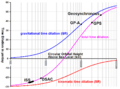
Graph showing how satellite time dilation changes depending on orbital altitude.


Related Pages
 In Spanish: Dilatación del tiempo para niños
